

Issaquah, Washington, tucked against the base of Tiger Mountain and nestled just east of Lake Sammamish, is a picturesque city with hiking trails minutes from your doorstep, high-performing schools, and access to major tech employers across the Eastside.
But all that desirability comes at a cost. If you’re considering moving here, you’ll want a realistic understanding of what daily life truly costs—not just rent or mortgage payments, but everything from utilities to groceries.
Below is a practical, grounded guide to Issaquah cost of living based on current market conditions and the lived experience of residents.

The Cost of Living Overview
When it comes to the cost of living in Issaquah WA, the first thing to understand is that it is significantly more expensive than the national average.
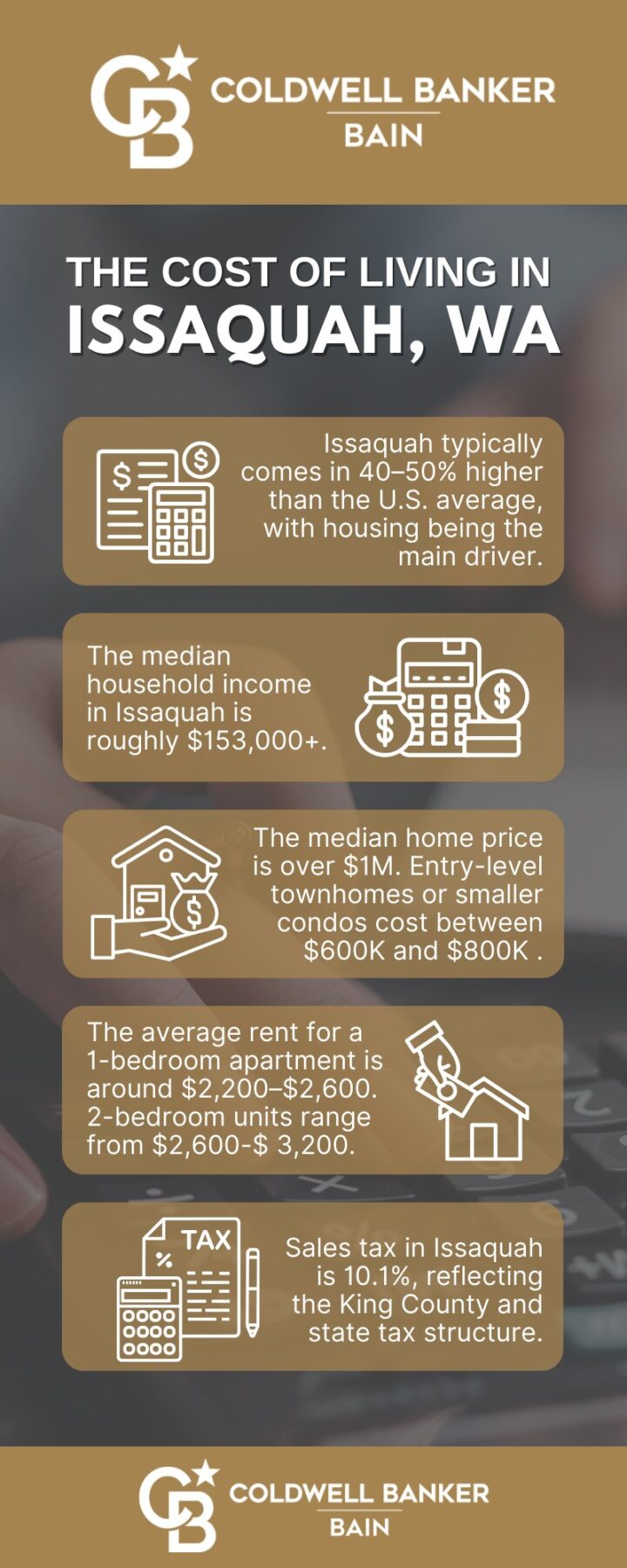
Depending on the cost index provider, Issaquah typically comes in 40–50% higher than the U.S. average, with housing being the main driver.
While everyday goods and services are somewhat elevated, it’s the real estate market that sets Issaquah apart.
To live comfortably here, household earnings need to be well above state norms. The median household income in Issaquah is roughly $153,000+, which is substantially higher than both the Washington state average and many cities around the Seattle metro.
That level of income isn’t a luxury—it’s what allows households to manage mortgage payments, childcare, outdoor recreation fees, and commuting costs without stretching too thin.
When comparing Issaquah to its neighbors, you’ll find it slightly more affordable than Bellevue, which consistently pushes into the highest-end price categories on the Eastside.
However, Issaquah is often comparable to or more expensive than parts of Seattle, largely because buyers here seek out larger suburban homes, modern construction, or master-planned neighborhoods with amenities—features that command larger premiums.
Housing: The Biggest Expense
Housing is the budget line item that shocks newcomers most.
Homeownership
As of 2025, median home prices in Issaquah exceed $1 million. That number varies by neighborhood and lot size, but it’s a safe starting point if you’re evaluating a single-family home.
Entry-level townhomes or smaller condos often begin in the $600K–$800K range, while well-located detached homes easily crest $1.3–$1.6M. Newer construction, especially in the hills, often asks even more due to views, finishes, and community amenities.
Buyers should also budget higher down payments and strong financial profiles; competition may not be as frantic as peak 2021–2022, but Issaquah remains a target market for tech professionals and relocating families.
Renting
The rental market follows similar Issaquah housing market trends.
A one-bedroom apartment typically runs around $2,200–$2,600 per month, while two-bedroom units often land between $2,600–$3,200+, particularly in sought-after communities like the Issaquah Highlands.
Newer complexes with gyms, coworking spaces, and secured parking command the upper ranges.
Neighborhood Differences
Issaquah home prices shift noticeably depending on where you land:
- Issaquah Highlands: Known for master-planning, parks, trail access, and modern builds. Expect higher purchase prices and HOA fees, along with a lifestyle tailored to convenience.
- Olde Town Issaquah: The historic core of the city, with charming older homes, tree-lined streets, and more local character. Housing stock may be more attainable, but renovations, parking quirks, or smaller lots can balance out the savings.

Property Taxes and Levies
One key perk of Washington is that there is no state income tax. The flip side is that other taxes fill the gap. Property taxes in Issaquah are influenced by King County’s assessed values, which have risen steadily over time.
As property values climb, so does the tax obligation, even if a homeowner isn’t actively making improvements. Homebuyers should plan for this in long-term budgeting.
A meaningful portion of property taxes supports the Issaquah School District, which is consistently ranked among the region’s top performers. School levies are voted in cycles and can make up a substantial part of your annual bill.
For families with school-aged children, this investment is often seen as worthwhile; for households without children, it’s still a reality tied to Issaquah’s quality of life.
Utilities and Infrastructure
Utility costs vary depending on lot size, HVAC usage, and neighborhood.
Providers
- Water/Sewer may be billed through the City of Issaquah or Sammamish Plateau Water, depending on the address.
- Electricity is primarily sourced from Puget Sound Energy (PSE).
- Garbage/Recycling services are typically bundled and billed alongside local utilities.
Hillside communities—like parts of the Highlands—can experience slightly higher water and sewer charges due to pumping and infrastructure complexity. Homes with irrigation systems or large landscaping also see elevated bills in summer.
For a typical household, expect a combined monthly utility bill in the $250–$400 range. Larger homes (2,500–3,500 sq. ft.), EV charging, or heavy heat use can push that higher.
Internet
High-speed internet is a non-negotiable for Issaquah’s remote-work crowd. Rates generally run $70–$120 per month, depending on speed tiers and bundling. Fiber-based options exist in many neighborhoods, though not universally—always confirm service before you sign a lease or purchase.

Daily Living: Groceries and Gas
Issaquah residents talk often about the “Eastside premium.” Daily expenses aren’t outrageous, but they do sit above average.
Grocery shopping at Fred Meyer, Safeway, Trader Joe’s, PCC, or Costco will feel a few percentage points higher than national norms. Organic and specialty products are widely available, reflecting the region’s demographics and demand.
Expect to spend more on fresh produce, meats, and prepared meals than you might in more rural or suburban parts of Washington.
Gas prices in Washington frequently run above national averages due to transportation taxes and regional factors. Issaquah isn’t immune.
Most residents rely on a car—especially if commuting to Bellevue, Redmond, or Seattle—so fuel and parking expenses add up quickly.
Sound Transit express buses provide alternatives, but they don’t eliminate the need for at least one personal vehicle for most households.
Lifestyle and Recreation Costs
Issaquah’s outdoor culture is part of its appeal—but even nature carries costs.
Dining out is not cheap. A casual dinner for two at a neighborhood restaurant often runs $60–$80, excluding wine or cocktails. Popular brunch spots, farm-to-table fare, and sushi restaurants push that number higher.
Recreation spending depends on your lifestyle:
- State recreation areas commonly require a Discover Pass.
- Fitness memberships and boutique gyms run similarly to those in Bellevue or Seattle.
- HOA fees in planned communities like the Highlands support parks, dog areas, community rooms, and neighborhood events. They’re a recurring expense you should treat like a utility bill.
Whether you join climbing gyms, own mountain bikes, or enroll kids in athletics, Issaquah’s recreational ecosystem is vibrant—and it’s easy to overspend if you’re not intentional.
Frequently Asked Questions
Generally, Issaquah and Redmond are close in price, but Redmond’s proximity to major tech campuses (Microsoft, Meta) can push housing demand higher in specific pockets. Issaquah may offer slightly better value for larger lots or suburban homes.
Sales tax in Issaquah is 10.1%, reflecting the King County and state tax structure.
Not at all. HOA fees are common in master-planned neighborhoods like Issaquah Highlands or Talus, but older areas—especially around Olde Town—often don’t have them.
Plan for $250–$350 per month, depending on heating source, season, and internet package.
The I-405 express toll lanes and the SR-520 bridge have variable tolls. If you’re working in Seattle, factor this into your commute budget.
Partially. High earners enjoy significant savings, but property taxes, housing premiums, and daily expenses absorb much of the gap.
Full-time daycare can run $1,600–$2,500+ per month, depending on provider, curriculum, and age group.
Key Takeaway
Issaquah isn’t a bargain destination—it’s a high-value market. You’re paying for miles of preserved trails, exceptional public schools, suburban comfort, and easy access to Bellevue, Redmond, and Seattle.
For families and professionals who prioritize outdoor living and educational quality, Issaquah delivers. Just arrive with a realistic budget, a plan for housing costs, and a mindset that you’re investing in lifestyle, not just square footage.
If you’d like to explore the real estate offerings in Issaquah, give me a call today at (206) 590-6316 or send me an email at amanda.wright@cbrealty.com to schedule an appointment.